
Environmental psychology · Meaning & belonging
Quick answer: Place attachment is the bond people develop with meaningful places, such as a home, neighborhood, park, or landscape. It often involves emotion, but researchers also study the memories, relationships, and actions that connect people to a setting. Scannell and Gifford’s person–process–place framework offers a useful way to understand who is attached, how the bond works, and what makes the place matter.[1]
You may miss a street that was never especially beautiful, feel drawn to a park where you once walked with someone important, or keep thinking about a home you no longer live in. The pull is not necessarily toward the buildings alone. It may be toward a routine, a relationship, a life chapter, or a sense of belonging that the setting holds.
Place attachment gives that experience a name. Understanding it can help us think more clearly about moving, community change, and the difference between liking a location and feeling that it matters.

What is place attachment in psychology?
In environmental psychology, place attachment describes a meaningful person–place bond. A useful starting definition is an emotional connection to a setting, but that shorthand should not hide the concept’s other dimensions. The research framework discussed here includes affect (feelings), cognition (memories, beliefs, and meanings), and behavior, such as returning to or maintaining proximity to a meaningful setting. Caring for or protecting a place can be possible expressions of attachment, but they are not proof of it; findings on attachment and pro-environmental behavior are inconsistent.[1]
Nor does “place” mean only a permanent residence. Attachment may concern a room, a garden, a neighborhood, a city, or a landscape. The social and physical features of the setting can both matter.[1] Think of a local café: someone may value its familiar layout, but also the conversations and relationships that happen there.
Important distinction: this is not a diagnosis or a personality type. Being attached to a place does not show that a person has a particular interpersonal attachment style, and it does not mean they ought to stay there regardless of their circumstances.
Place attachment theory: the person–process–place framework
There is no single theory that resolves every question about place attachment. In their 2010 review, Leila Scannell and Robert Gifford organized varied definitions into three connected dimensions. Their framework is a research lens, not a sequence of stages or a test that assigns someone a score.[1]
Person: who is attached?
The bond can carry individual meaning, such as a personal milestone, or shared meaning, such as community history and cultural practice.
Process: how does it work?
Consider feelings, memories and beliefs, and behavior. A person might feel comfort, recall important experiences, and regularly return.
Place: what matters here?
Look at the scale of the setting and its social and physical features: a particular room, a neighborhood, people, paths, or landscape.
All three descriptions above summarize the same framework.[1] They are not three separate “types” of person.
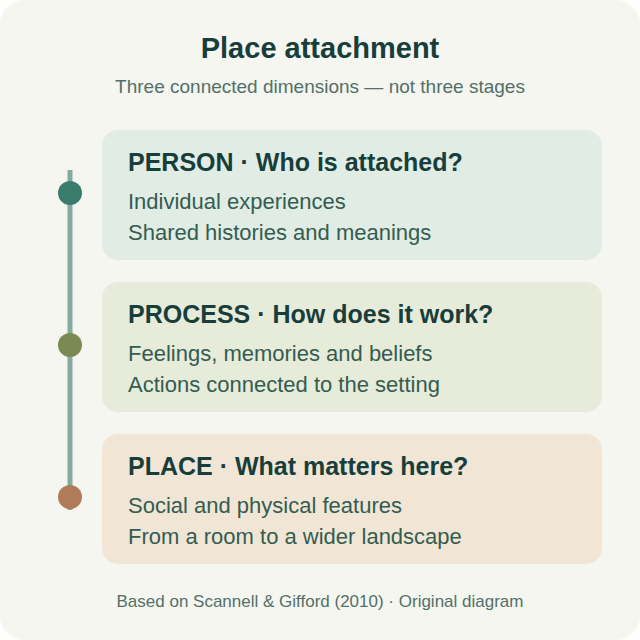
A worked example: imagine a community garden. The person dimension might include one gardener’s memories and a group’s shared history. The process dimension might include pride, knowledge of the plants, and volunteering. The place dimension includes the garden’s paths, soil, meeting space, and social life. This is an illustrative case, not a finding about every garden.
Six everyday examples of place attachment
The examples below are hypothetical. They show how the concept can be used without assuming that everyone experiences the same setting in the same way.
1. A childhood home
A person remembers a kitchen table, the sound of a door, or a tree outside a bedroom window. The home matters because of experiences associated with it, even if the building has changed. Someone else from the same household may have a very different relationship with that address.
2. A neighborhood walking route
A familiar path can link everyday movement with recognizable faces, a favorite view, and small rituals. Attachment here is not simply “I know how to get around.” It is the significance the route carries.
3. A school or university campus
A courtyard may bring back friendships, difficult years, a sense of independence, or an achievement. The physical setting becomes connected with a life chapter rather than remaining interchangeable with any other campus.
4. A park or community garden
A green space may matter through repeated visits, gardening, recreation, and social interaction. The University of Washington’s research summary describes parks and natural areas as settings where attachment and meaning can develop through varied experiences.[2] Access matters: a space that welcomes some users may remain inaccessible to others.
5. A hometown after moving away
Someone living elsewhere still returns to familiar streets or maintains a connection through stories, photographs, and people. Physical distance and emotional significance are different questions. Missing the town does not, by itself, establish that returning would be the best decision.
6. A meaningful landscape
A beach, mountain trail, or riverside may hold family memories or a treasured activity. The bond can concern both the landscape’s physical qualities and the experiences it makes possible.
Place attachment vs. place identity, sense of place, and place dependence
These terms overlap. Some studies include identity and dependence as dimensions of attachment; others separate the concepts differently. The table is a practical guide, not a universal taxonomy.[1]
| Concept | Main question | Illustrative example |
|---|---|---|
| Place attachment | How am I bonded to this setting? | “I feel connected to this park and miss it when I am away.” |
| Place identity | How does this place relate to who I am? | “Growing up in this coastal town is part of my life story.” |
| Sense of place | What meaning or character does this place have? | “The market feels like a meeting point for local life.” |
| Place dependence | How well does this setting support my activities compared with alternatives? | “This accessible trail suits my walking needs better than nearby routes.” |
For the self-concept dimension, see Place Identity Theory: Definition, Examples & Key Concepts. For the broader meanings and character of a setting, read Sense of Place: Meaning, Examples & Placelessness. This article focuses on the bond itself.
Why moving or neighborhood change can feel personal
The place-attachment literature helps explain why relocation can involve more than a change of address. Scannell and Gifford discuss research on distress associated with forced relocation and the relevance of person–place bonds to mobility, immigration, and disaster contexts.[1] Those experiences should not be treated as equivalent: a voluntary move, housing insecurity, and forced displacement involve different levels of choice and risk.
A person may be responding to lost relationships, familiar routines, meaningful landmarks, or access to an activity—not simply resisting something new. Equally, a place can hold conflict and painful memories alongside affection. Researchers differ in how they describe negative person–place bonds: attachment is often defined positively, while emotionally significant relationships with places can also be painful or mixed. Recognizing a bond is not a reason to pressure someone to remain in an unsafe or unaffordable situation.
For community decisions, the useful question is not just “Do residents like this place?” It is “What relationships, activities, memories, and practical needs might this change preserve or disrupt?” The University of Washington summary highlights attachment and meaning as relevant to urban development and community-building.[2]
A five-question reflection on a meaningful place
Make the connection specific
- Name the setting. Is it one room, a street, a public space, or a wider landscape?
- Separate people from physical features. What matters most: the setting, the relationships, or their combination?
- Notice feelings and meanings. Does it hold comfort, pride, longing, grief, or mixed emotions?
- Identify what you do there. Which routines, activities, or responsibilities connect you to it?
- Consider what can travel with you. A story, relationship, or practice may be preserved even if the exact setting cannot.
This is an editorial reflection exercise, not a validated place attachment scale or treatment. You do not need to turn your answers into a score. If you are considering a move, use them alongside practical questions about safety, finances, support, and opportunity.
Frequently asked questions
Is familiarity alone enough to show place attachment?
No. Recognizing a setting or knowing a route does not by itself establish a meaningful bond. Consider the feelings, personal or shared meanings, and relationship with the setting rather than familiarity alone.[1]
Can you feel place attachment without living there?
Yes. Attachment is not limited to a current home: research also considers natural areas and recreation settings.[2] A park you visit or a landscape connected with important experiences can matter without being your residence.
Is place attachment the same as place identity?
Not exactly. A useful distinction is that attachment concerns the bond with a setting, while identity concerns how it contributes to self-understanding. Researchers sometimes treat identity as part of the broader attachment construct rather than a completely separate category.[1]
What is the Scannell and Gifford model of place attachment?
It is a person–process–place organizing framework published in 2010. It considers individual and collective meanings, emotional/cognitive/behavioral processes, and the social and physical characteristics of the setting.[1]
Does attachment mean a place is good for everyone?
No. One person’s meaningful setting may be another person’s uncomfortable or inaccessible environment. The concept is a way to ask about relationships with a place, not a certificate of safety, fairness, or universal belonging.
A place can matter without deciding your future
You do not have to dismiss a meaningful place as “just a building,” and you do not have to let attachment make every decision for you. Naming the bond makes it possible to ask a better question: what, exactly, do I want to preserve—and what do I need to change?
That distinction leaves room for memory and movement, belonging and choice. The place matters; so do the people whose lives continue beyond it.
Editorial note: Prepared for Emotion Nest in October 2026 as an educational social-science explainer. Its foundational sources are a 2010 organizing framework and a 2014 university literature summary, not a comprehensive review of research through 2026. Research summaries are cited below; everyday scenarios and the reflection exercise are editorial illustrations. This is not a diagnostic assessment or individualized mental-health advice.
Sources and further reading
- Scannell, L., & Gifford, R. (2010). Defining place attachment: A tripartite organizing framework. Journal of Environmental Psychology, 30, 1–10. DOI: 10.1016/j.jenvp.2009.09.006. Open PDF copy.
- University of Washington, Green Cities: Good Health. Place Attachment & Meaning. Research summary by Wolf, Krueger, and Flora, completed August 2014.