
Quick answer: A sense of place is the mix of meanings, feelings, memories, activities, and physical qualities that make a location matter to people. It can describe both a place’s perceived character—what makes a neighborhood, park, or town feel distinct—and a person’s or community’s relationship with it.
A place is more than a point on a map. It may be a familiar walk to school, a market where people meet, a coastline associated with family stories, or a public square whose meaning is debated. The same setting can feel welcoming, ordinary, restrictive, or painful to different people. That is why sense of place is useful in geography, environmental psychology, planning, and community research—but should not be treated as one universal feeling shared by everyone in a location.

What does sense of place mean?
In plain language, sense of place describes how people experience and interpret a location. It includes the setting itself—such as streets, buildings, landscapes, sounds, access, and local history—but also the meanings people connect to it. A place can become meaningful through repeated use, a major event, cultural traditions, social relationships, or the opportunities it offers.
Scholars use the term in more than one way. It can refer to a location’s distinctive character, to a person’s emotional connection with it, or to shared meanings held by a group. A useful review from the University of Washington’s Green Cities: Good Health project explains that place-related bonds and meanings develop through varied experiences and situations. That breadth is a strength of the concept, but it also means definitions should be stated clearly rather than assumed.
Original diagram: a sense of place emerges from the interaction of setting, experience, relationships, and shared meaning—not from one feature alone.
Examples of sense of place
These examples show how meaning can form around ordinary settings. They are illustrations, not universal rules:
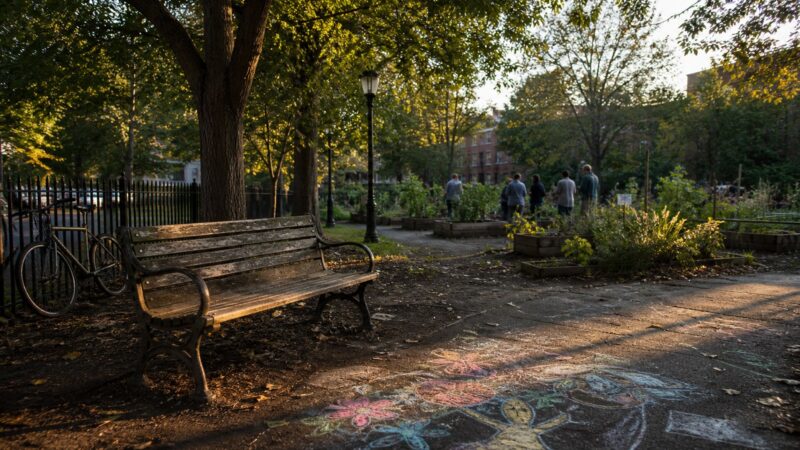
- A neighborhood park: regular walks, familiar faces, local trees, and community events can make a park feel like part of everyday life.
- A school or campus: routines, friendships, achievements, and shared rituals may give the same buildings significance far beyond their practical function.
- A coastal town: working patterns, weather, local language, family stories, and access to the shore can shape how residents describe the town’s character.
- A transit station: it may be merely functional for one commuter, while another connects it with arrival, departure, safety, crowding, or a particular life period.
Sense of place vs. place identity, place attachment, and place dependence
These terms overlap, and researchers do not use them identically in every discipline. The distinctions below are practical rather than a single universal taxonomy:
| Concept | Primary focus | Helpful question |
|---|---|---|
| Sense of place | The meanings, character, and lived experience associated with a location. | “What does this place feel like or stand for?” |
| Place identity | How a meaningful place contributes to self-understanding. | “Is this place part of who I am?” |
| Place attachment | An emotional or affective bond with a particular setting. | “How connected do I feel to this place?” |
| Place dependence | The functional value of a setting for needs, activities, or goals compared with alternatives. | “Does this place help me do what I need to do?” |
This article focuses on the broader idea of sense of place. For the narrower self-concept dimension, see our guide to place identity theory. A strong emotional bond does not automatically mean a place is part of someone’s identity, and a place may have a powerful shared character without being experienced the same way by every resident.
How does a sense of place develop?
There is no fixed formula. Research commonly considers the interplay between people, experiences, and environments. The physical setting supplies possibilities and constraints; people interpret those conditions through their history, relationships, needs, and cultural context. The Frontiers in Psychology review by Raymond, Kyttä, and Stedman describes both immediate perception and slower social construction as relevant to sense of place.
- Familiarity and routine: repeated routes, sounds, views, and activities can make a setting easier to recognize and interpret.
- Relationships and participation: places acquire social meaning through meeting people, caring for a shared space, celebrating, learning, working, or organizing.
- Memory and life events: a setting may become important because of personal milestones, family history, loss, migration, or change.
- Culture and representation: names, stories, traditions, art, language, and media can shape which features people notice and value.
- Physical conditions and access: safety, affordability, mobility, green space, housing, and the ability to use or influence a place affect whose experiences are possible.
What is placelessness?
Placelessness is often used to describe a perceived loss of distinctiveness, local meaning, or connection to a setting. The term is closely associated with geographer Edward Relph’s work on place and placelessness, including his 1976 book Place and Placelessness. It is commonly discussed in relation to standardized design, rapid redevelopment, displacement, or environments that seem interchangeable.
It is not a technical diagnosis for a “bad” place, and it should not be applied from a photograph alone. What feels anonymous or standardized to one person may be convenient, safe, or meaningful to another. The value of the concept is that it prompts questions: whose memories, local practices, and access are being preserved or changed? A 2022 Ecology and Society article likewise treats meaningful places as shaped by both immediate perception and socially constructed meanings.

Why sense of place matters in community change
Sense of place can help explain why proposals about transport, parks, housing, heritage, or redevelopment produce strong and sometimes conflicting responses. People may be responding not only to a building or a route, but to memories, daily practices, cultural symbols, livelihoods, access, or concerns about who will be able to remain.
That does not make every claim about a place equally supported, nor does it mean that preserving the status quo is always fair. It does mean that decisions can be improved by asking whose experiences are missing and by combining local knowledge with evidence about housing, mobility, environment, and public services.
Frequently asked questions
What is a simple definition of sense of place?
Sense of place is the meaning and character people associate with a location, shaped by the setting itself and by lived experience, relationships, culture, and memory.
What is an example of a sense of place?
A neighborhood park can develop a sense of place through familiar paths, local events, people who meet there, memories, and the way the space is cared for. Another person may experience the same park differently.
Is sense of place the same as place identity?
No. They overlap, but place identity is specifically about how a place contributes to self-understanding. Sense of place is broader: it can refer to a place’s perceived character and the meanings people or communities associate with it.
What is placelessness in human geography?
Placelessness is a term used for a perceived loss of local distinctiveness or connection. It is often associated with uniformity or changes that weaken familiar meanings, but it is subjective and should not be used as a blanket judgment about people or places.
Sources and further reading
- University of Washington: Place Attachment & Meaning
- Raymond, Kyttä & Stedman (2017): Sense of Place, Fast and Slow
- Ecology and Society (2022): Using meaningful places as an indicator for sense of place
- Yi-Fu Tuan: Space and Place: The Perspective of Experience
- Edward Relph: Place and Placelessness (1976 bibliographic record)
Reviewed August 2026. This educational article explains a social-science concept; it does not measure, diagnose, or define any individual’s relationship to a place.
Related reading: Place Identity Theory · Types of Social Justice · Psychology & Social Science Reference Library