
Sociology · Norms & everyday life
Quick answer: Social sanctions are responses that reward conformity to a group’s norms or express disapproval of a violation. Positive sanctions offer approval or rewards; negative sanctions express disapproval or impose penalties. Either can be formal, through an official organizational process, or informal, through everyday interaction. These are two separate distinctions, not four mutually exclusive types.[1]
A quiet “thank you,” an official service award, a disapproving comment, and a written workplace warning can all help communicate what a group expects. The useful question is not simply whether a reaction feels pleasant. It is what behavior is being encouraged, who is responding, and in what capacity.
This guide explains the distinctions with 12 hypothetical examples. Then try the six-case classification lab: decide for yourself before revealing each explanation. No account, score, or personal information is needed.
What are social sanctions in sociology?
In sociology, a sanction is a response through which people or institutions reinforce a norm. A norm is the expectation; a sanction is a reaction connected to following or breaking it. OpenStax discusses sanctions as a means of social control—the regulation and enforcement of norms.[1]
For example, “give credit when using someone else’s work” is a norm. Thanking a collaborator for careful attribution is a positive response. An official disciplinary decision after a policy violation is a negative one. The expectation and the response are related, but they are not the same thing.
This article uses “social sanctions” in that broad sociological sense, including both official and everyday responses. It is not a guide to international economic sanctions, and “sanction” here does not mean permission or authorization, another meaning of the word.
For the expectations themselves, see our comparison of folkways, mores, and laws. That guide classifies norms; this one classifies responses to them.
Positive vs. negative, formal vs. informal sanctions
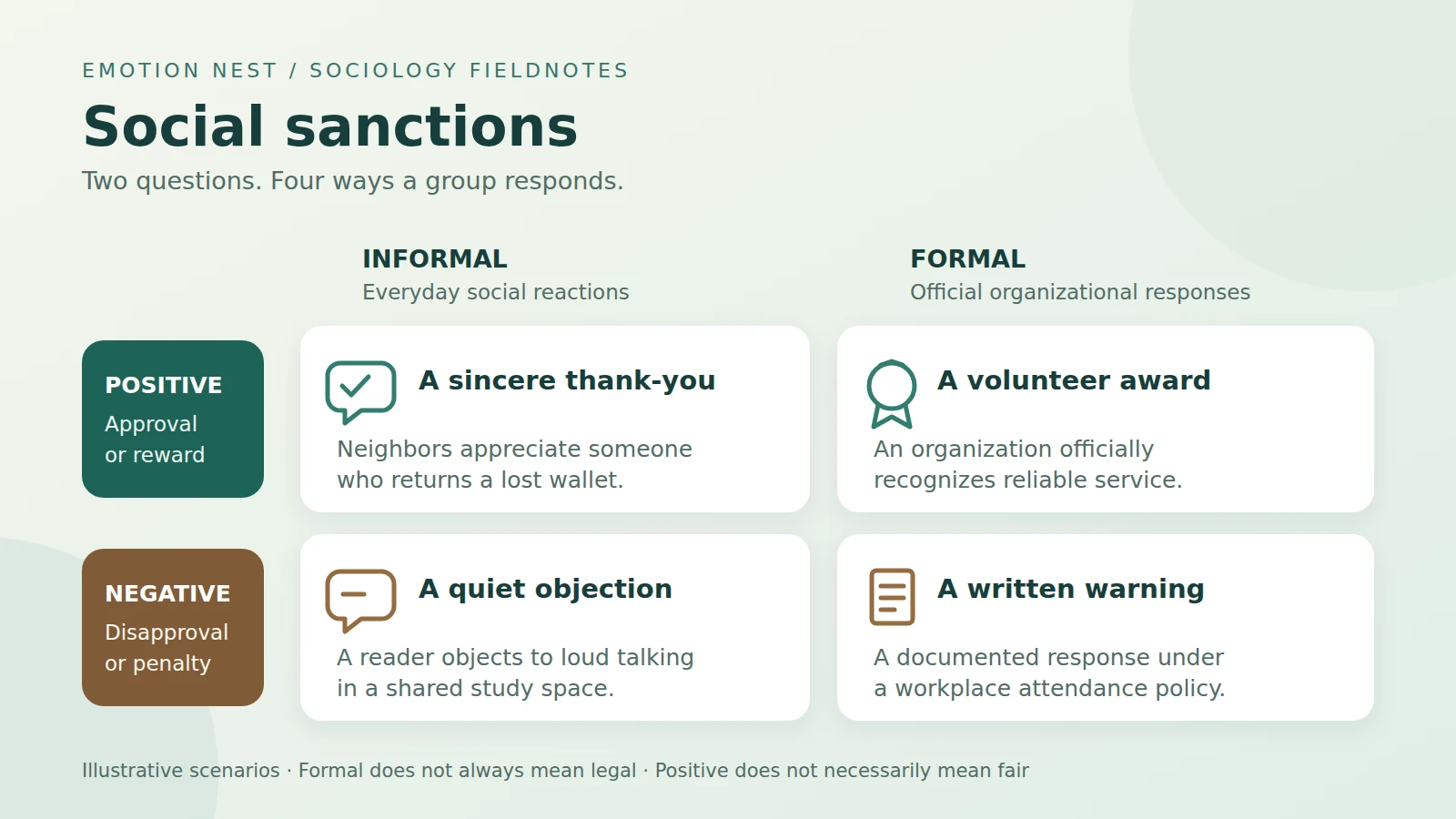
Ask two independent questions: Is the response approving or disapproving? Then ask: Is it an official response or an everyday social reaction? OpenStax’s introductory framework combines these dimensions in a two-by-two table.[1] Here is an original set of examples using that distinction:
| Response | Informal: everyday interaction | Formal: official process |
|---|---|---|
| Positive: approval or reward | Neighbors thank someone for returning a lost wallet. | A community organization grants an annual service award. |
| Negative: disapproval or penalty | A reader objects to loud conversation in a quiet study area. | An employer issues a written attendance warning under its disciplinary policy. |
Positive does not necessarily mean fair
“Positive” identifies approval or reward, not an ethical verdict. A group could reward conduct that outsiders consider harmful. Likewise, “negative” describes disapproval or penalty; it does not establish whether that response is justified, proportionate, or effective. Classify the response first, then evaluate it.
Formal does not necessarily mean legal—or severe
Schools, employers, clubs, and professional bodies can administer formal sanctions under their own rules. A response does not need to involve police or a court to be formal. An official award can be formal and positive; a harsh unofficial insult can be informal and negative.[1] Severity and formality are different questions.
A manager can also react in different capacities. A casual “thanks for covering that shift” is ordinarily informal praise. An official recognition bonus awarded through an employer’s program is formal. The person’s job title alone does not settle the classification.
12 everyday examples of social sanctions
All scenarios below are editorial illustrations, not findings about particular workplaces, schools, or cultures. Their classifications depend on the details stated.
Positive informal sanctions
- Returning a wallet: a neighbor thanks the finder. The reaction approves honesty without an official award.
- Sharing credit: colleagues spontaneously praise a teammate who acknowledges everyone’s contribution. The praise supports a norm of fair attribution.
- Keeping a shared space usable: housemates express appreciation when someone cleans up after cooking. The reward is everyday social approval.
Negative informal sanctions
- Interrupting a conversation: a friend says, “Please let her finish.” The correction disapproves of interrupting without invoking a formal procedure.
- Breaking a confidence: peers criticize someone for sharing a story they were asked to keep private. The criticism communicates a violated expectation of trust.
- Ignoring a queue: people waiting object when someone moves ahead of them. Their response is social correction, not automatically a legal penalty.
Positive formal sanctions
- Reliable volunteering: a nonprofit grants a service award under its recognition program. Approval is officially recorded.
- Following safety procedures: an employer awards a policy-based recognition bonus for documented safety contributions. The reward is administered by the organization.
- Academic integrity: a school presents an official award recognizing responsible research and attribution. The response rewards a stated institutional expectation.
Negative formal sanctions
- Repeated lateness: an employer issues a written warning under its attendance procedure. The warning is official discipline.
- Plagiarism: a university disciplinary panel imposes a penalty under its academic-integrity rules. The sanction is institutional even without a criminal case.
- Breaking a club’s conduct policy: an authorized committee suspends membership after its disciplinary process. The consequence is formal rather than merely peers expressing disapproval.
Notice what the examples do not prove: they do not show that rewards or punishments always change behavior, that the response is lawful in every jurisdiction, or that an organization acted fairly. Those questions require additional evidence and context.
One setting, four different responses
Imagine a community reading group that expects members to credit the author of any passage they share. One member carefully names the writer and edition. Another later presents someone else’s paragraph as their own. Several responses are possible:
- Informal positive: a member says, “Thanks for making the source easy to find.”
- Formal positive: the group’s authorized committee grants its published annual research award.
- Informal negative: peers criticize the unattributed passage during discussion.
- Formal negative: the committee issues a warning under the group’s written integrity procedure.
The same setting can contain all four combinations. What changes is the response and its authority—not necessarily the building, the people involved, or the underlying norm. A single incident can attract more than one sanction.
To place these interactions in a wider context, explore real-world examples of social systems: roles, relationships, rules, and institutions operate together rather than in isolation.
How sanctions relate to mores, culture, and power
Mores are norms with moral significance for a group; folkways concern customary everyday conduct. Sanctions are not a third kind of norm. They are responses that can reinforce either kind. OpenStax describes mores as guarded by public sentiment, with some also protected by law or other formal sanctions.[2]
Describing a sanction is not endorsing it. Ask who defines the rule, who can challenge a decision, and whether the same conduct receives different responses depending on status or belonging. A reaction that maintains conformity can still deserve criticism.
Context matters, too. A brief silence could express disapproval, but it could also reflect distraction, uncertainty, or not hearing someone. Do not infer a sanction from an ambiguous gesture without evidence linking it to a norm. For a broader introduction to values, symbols, and shared expectations, read what culture includes.
Try the six-case classification lab
For each case, choose positive or negative, then formal or informal—or decide that there is not enough evidence to classify the response. Open the card to compare your reasoning with the explanation. These are learning examples, not a validated test or an assessment of a real person’s motives.
1. A teammate privately thanks you for acknowledging their contribution.
Positive + informal. The response is approval in an everyday exchange. No official award or institutional procedure is described.
2. A school committee formally recognizes a student for responsible research.
Positive + formal. The institution officially rewards conduct it values. “Formal” does not mean the consequence must be a punishment.
3. A friend objects when someone repeatedly talks over another person.
Negative + informal. The objection expresses disapproval of interrupting. A response can be polite and still be a negative sanction in this framework.
4. A club’s disciplinary panel suspends a member under its conduct rules.
Negative + formal. An authorized body imposes an official penalty. It need not be a court decision or a criminal punishment.
5. Your manager says, “Nice job helping the new colleague.”
Usually positive + informal, as described. A manager’s spontaneous praise is not automatically a formal sanction. If the words accompany an official award decision, that additional detail changes the analysis.
6. A colleague does not reply to your greeting. No other information is available.
Not enough evidence. The colleague might be distracted or might not have heard. Before classifying the silence as a negative informal sanction, establish that it expresses disapproval connected to a norm. Refusing to over-classify is part of the exercise.
A five-line worksheet for your own example
Use this template for a class discussion, reading group, or workplace case. Describe observable details rather than guessing what someone “really meant.”
- Norm: What behavior is expected, and by which group?
- Response: What did a person or institution actually do?
- Direction: Does it convey approval or reward, disapproval or penalty, or is that unclear?
- Authority: Is it everyday interaction or an official organizational action? What evidence supports that?
- Limits: What is still unknown about context, fairness, or outcome?
A strong explanation might read: “The expectation was to credit sources. The committee issued a documented warning under its integrity policy, so the response was negative and formal. The description does not establish whether the decision was fair or whether future behavior changed.”
Frequently asked questions
Can social sanctions be positive?
Yes. Approval, praise, and official rewards can reinforce norms just as disapproval and penalties can respond to violations. In the introductory sociological framework, sanctions include both positive and negative responses.[1]
What is the difference between formal and informal sanctions?
Formal sanctions are official organizational responses, such as a policy-based award or disciplinary warning. Informal sanctions arise in everyday interaction, such as thanks or criticism. Either can be positive or negative.[1]
Is every punishment a legal sanction?
No. A school or club can impose an official penalty under its own rules without a criminal prosecution. Conversely, disapproval among peers can be informal. Do not equate “negative,” “formal,” and “legal.”[1]
Is social control the same as Hirschi’s social control theory?
No. Social control is the broad process of regulating and enforcing norms discussed here.[1] Hirschi’s social bond approach is a particular criminological explanation, not another name for the four sanction combinations. See our separate introduction to Travis Hirschi and social control theory for that distinct topic.
Read the response, not just the label
The most useful habit is to name the expectation and describe the response before assigning a category. Two questions—approval or disapproval, official or everyday—can clarify a confusing example. A third question, “What do I still not know?”, prevents a neat classification from becoming an unfair judgment about people.
Editorial note: Prepared for Emotion Nest in October 2026 as an educational sociology explainer. Definitions are grounded in the introductory sources below. The scenarios, classification lab, worksheet, and visual map are original editorial teaching materials, not research findings or professional advice. No claim is made that a particular sanction is effective or justified simply because it can be classified.
Sources and further reading
- OpenStax, Introduction to Sociology 3e, §7.1: Deviance and Control. See the Social Control section and Table 7.1 for the positive/negative and formal/informal distinctions.
- OpenStax, Introduction to Sociology 3e, §3.2: Elements of Culture. See the discussion of values, norms, mores, folkways, and sanctions.